How to Convert OLM to MBOX for Mac – Quick Guide [2026]

Neeru Kuchhal

July 6th, 2026
User-Query:
“I have a 14GB OLM file from Outlook for Mac containing around 22,000 emails, attachments, contacts, and archived folders. I now want to convert it into MBOX format so I can access my data on my MacBook. What is the safest and fastest way to convert OLM to MBOX without losing my email structure and attachments?”
— Posted by “Jessica Morgan”
Introduction: OLM (Outlook for Mac Data File) is the native mailbox file format used by Microsoft Outlook for Mac. It stores emails, contacts, calendars, notes, and attachments. Many Mac users rely on OLM files for backup and mailbox archiving. However, OLM files are limited to Outlook for Mac. If you want to open your mailbox data in other email clients, converting OLM into MBOX is the best solution. MBOX is one of the most widely supported mailbox file formats, used by over 20+ email clients globally.
Besides, this guide explains the quickest methods to convert an OLM file to MBOX on a Mac using the OLM Converter Tool.
Therefore, this guide explains the best ways to migrate emails from OLM to IMAP using the MacSonik OLM Converter Tool.
Key Note: Studies show that 63% of Mac users prefer MBOX-supported clients for long-term mailbox management because of better flexibility and compatibility.
OLM to MBOX: Why the Conversion Is Needed on Mac?
There are multiple reasons due to which users convert OLM to MBOX:
- Access Outlook for Mac emails in Apple Mail.
- Import OLM mailboxes into Thunderbird.
- Create flexible cross-platform email backups.
- Simplify mailbox migration between Mac systems.
- For preserving archived Outlook emails.
- Also, to reduce dependency on Outlook.
Businesses with long-term archives often convert 10GB–30GB OLM files for better storage management and easier access.
Steps to Manually Convert OLM to MBOX File on Mac
The manual process involves using Outlook for Mac and an IMAP sync method. Here are the step-by-step instructions:
Method 1. Outlook for Mac + IMAP + Thunderbird
- Open Microsoft Outlook on your Mac.
- Import the OLM file that you want to convert.
- Configure an IMAP account.
- Move emails from OLM folders into IMAP folders.
- Open Mozilla Thunderbird on your Mac.
- Sync the same IMAP account.
- Export the mailbox using Thunderbird’s ImportExportTools add-on.
Method 2. Convert OLM to MBOX Using the Drag & Drop
- First, open Microsoft Outlook for Mac and go to Tools and then, Import.
- Select “Outlook for Mac archive file (.olm)” and click Continue.
- Browse and import the OLM file. The items will appear in the “On My Computer” section of the sidebar.
- Select the specific mail folders you wish to convert and simply drag and drop them onto your Mac Desktop.
- Outlook will automatically package those folders into individual .mbox files.
Troubleshooting OLM to MBOX Conversion Issues
- OLM files are not supported by most email clients.
- Manual conversion methods are complex.
- There is a risk of missing attachments.
- Email metadata may change.
- The older hierarchy can break.
- Large OLM files take longer to process.
- Moreover, duplicate emails can occur during migration.
Reliable Mac Solution to Export OLM to MBOX
While the manual methods work, they are not ideal for large migrations. The MacSonik OLM Converter Tool supports large and bulk OLM files in one go. It completes the process with no restrictions and data loss. This software has the ability to import OLM to Thunderbird and more supported file formats while preserving the metadata. Additionally, the tool comes with a trial edition that supports converting 50 emails from each folder.
One-Time Conversion Service Option
If you have large OLM files or multiple user mailboxes, MacSonik offers a one-time conversion service. Their experts can securely migrate OLM to MBOX on your behalf.
One-Time Service for Just $35 – Supports Files Up to 10 GB.
Stepwise Guide to Convert OLM to MBOX on Mac
- Firstly, install and launch the MacSonik OLM Converter Tool.
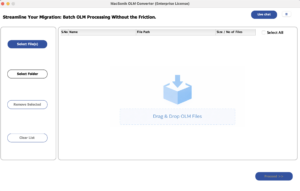
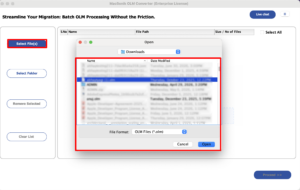
- Click Select Files/Folders to add the OLM file that you wish to convert.
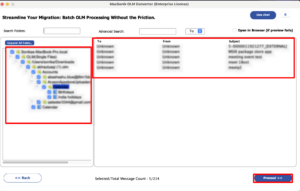
- Expand the hierarchy, preview the entire mailbox folder, and click Next to move ahead.
- Afterwards, choose MBOX Mail Archive (.mbox) as the saving file format.
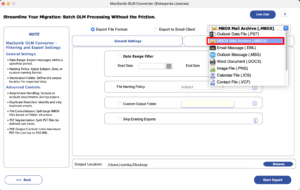
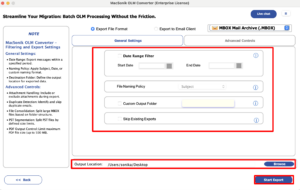
- Finally, apply the advanced filters as needed, set the destination to save the file, and click Convert to begin the conversion.
Want to Explore More? You can directly convert OLM to PST as well.
MacSonik vs RecoveryTools: Compare Before You Buy
|
Optimized Features |
MacSonik OLM Converter |
RecoveryTools OLM Converter |
|
Fully optimized for Mac (Intel + Apple Silicon M1/M2/M3) |
Basic Mac support |
|
Unlimited |
Limited |
|
High |
Low |
|
Date, subject, sender, receiver filters |
Basic date filter only |
|
MBOX, PST, PDF, Gmail, Office 365, IMAP, Yahoo |
Fewer cloud migration options |
|
Up to 35% faster on large Mac mailboxes |
Standard processing speed |
|
24/7 dedicated support |
Limited support hours |
|
More generous preview and conversion trial |
Limited export in demo |
|
More features at better ROI |
Similar price with fewer enterprise-grade features |
What Makes MacSonik Worth Buying?
- Built specifically for Mac users, unlike many general-purpose converters.
- Better performance for large OLM files (50GB–100GB+).
- Higher conversion accuracy (99.9%) for business-critical data.
- Better at preserving folder hierarchy, attachments, and metadata.
- More migration destinations and export formats.
- Advanced duplicate management reduces mailbox clutter.
- Better long-term value for IT teams, enterprises, and power users.
- Faster processing means less downtime during migration.
Real-Life Scenario: Team Collaboration Upgrade
A law firm using Mac Outlook had over 18GB of archived OLM files containing client communication and legal attachments. They needed to move the data into Thunderbird for easier long-term access.
The manual IMAP method was estimated to take over 9 hours.
Using the MacSonik OLM Converter on Mac, it move OLM to MBOX file and the entire conversion finishes in under 2 hours, preserving all folder hierarchy and attachments.
Reminder: The MacSonik software also allows users to migrate OLM to HTML with 100% accuracy and high security.
Conclusion
In this write up, converting OLM to MBOX on Mac is the best option for email client compatibility. While manual IMAP methods can work for smaller OLM files, they become time-consuming and risky for large mailboxes. If you are handling 10GB+, the OLM Converter is the better choice to convert OLM to MBOX. Apart from that, it provides:
- Faster bulk conversion
- 99.9% data accuracy
- Complete attachment preservation
- Large OLM support
- Duplicate handling
- Advanced filters
- Full Mac compatibility
- Local system processing for better privacy
Frequently Asked Questions
Ans. You can shift OLM to MBOX without Outlook by using a dedicated MacSonik OLM converter tool. This directly reads OLM files and exports them into MBOX format while preserving emails, attachments, and folder hierarchy, making the process easier for Mac users.
Ans. To bulk convert multiple OLM files, use a professional MacSonik OLM migration tool that supports batch conversion. Simply add multiple OLM files, select MBOX as the output format, and start the conversion. This saves time and is ideal for users handling large mailbox archives.
Ans. The best way to maintain folder hierarchy is by using a reliable OLM to MBOX converter. This advanced tool preserves the original folder structure, subfolders, and mailbox organization exactly as they exist in the source OLM file.
Ans. Organizations usually use enterprise-grade OLM converter software for bulk migration. It supports multiple OLM files, large mailbox sizes, and advanced filtering while ensuring complete data integrity, making them suitable for business and compliance-based migrations.
Ans. Yes, the professional MacSonik OLM converter tool provides a preview feature. This allows users to review emails, attachments, and folder structures before starting the conversion, helping ensure only the required data is exported.
Ans. Yes, an advanced OLM migration tool offers date-range filters and other selective options. This allows users to convert only specific emails based on date, sender, subject, or folder, which helps reduce unnecessary data and makes the conversion process more efficient.
About The Author:
I am Neeru Kuchhal, a Technical Content Writer who focuses on turning complex ideas into clear, engaging, and impactful content. I combine creativity with strategy to write blogs, web content, and technical articles that connect with the right audience and support brand goals. I believe great content is not just written. It is thoughtfully created to inform, build trust, and drive action.
Related Post